
When your MacBook gets stuck on the Apple logo during startup, it usually means macOS has started the boot process but cannot finish loading.
The problem can be caused by corrupted system files, a failed macOS update, incompatible startup software, disk errors, or hardware issues. In many cases, the Mac can be repaired without erasing your data if you follow the right troubleshooting steps in the correct order.
This guide explains why the problem happens, how to identify the likely cause, and the safest ways to get your MacBook working again. The steps apply to most MacBook Air and MacBook Pro models, although entering recovery mode differs depending on whether your Mac has an Intel processor or Apple Silicon (M1, M2, M3, or newer).
Why a MacBook Gets Stuck on the Apple Logo
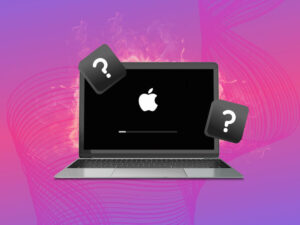
The Apple logo appears after your Mac successfully completes its initial hardware checks. At this stage, macOS begins loading the operating system from the startup disk.
If the loading process cannot continue, the progress bar may stop moving or disappear entirely, leaving the Mac frozen on the Apple logo.
Common causes include:
- An interrupted macOS update
- Corrupted system files
- Startup disk errors
- Insufficient free storage
- Faulty startup extensions or login items
- External devices interfering with startup
- Hardware problems involving the SSD, memory, or logic board
Understanding the cause helps you choose the right solution instead of trying random fixes that may waste time or risk data loss.
Before You Start Troubleshooting
Before attempting repairs, check a few simple things first.
Give the Mac Enough Time
If the Mac recently installed a macOS update, startup may legitimately take longer than usual.
Wait at least 20 to 30 minutes before assuming the Mac is frozen. Some updates perform disk migration or optimization that can make the progress bar appear stuck for an extended period.
Connect the Charger
A low battery can interrupt startup or recovery operations.
Connect the original Apple charger or a compatible USB-C power adapter before continuing.
Disconnect External Devices
Disconnect everything except the power cable.
Remove:
- USB drives
- External SSDs
- Thunderbolt accessories
- Docking stations
- Printers
- SD cards
- External displays when possible
A faulty accessory or bootable external drive can prevent macOS from starting correctly.
Force Restart the MacBook
Sometimes the operating system simply freezes during boot.
To perform a force restart:
- Hold the Power button for about 10 seconds.
- Wait until the screen turns completely black.
- Wait another 10 seconds.
- Press the Power button again.
If the Mac starts normally, monitor it over the next few days. If the issue returns, continue with the remaining troubleshooting steps.
Start in Safe Mode
Safe Mode starts macOS with only the essential components needed to boot.
It also performs several automatic checks, including verifying the startup disk and clearing certain system caches.
On Apple Silicon Macs
- Shut down the Mac completely.
- Press and hold the Power button.
- Continue holding until Startup Options appear.
- Select your startup disk.
- Hold the Shift key.
- Click Continue in Safe Mode.
On Intel Macs
- Shut down the Mac.
- Turn it back on.
- Immediately hold the Shift key.
- Release the key when the login screen appears.
If the Mac boots successfully in Safe Mode:
- Restart normally.
- Remove recently installed software.
- Uninstall antivirus tools if the issue began after installation.
- Check for available macOS updates.
Safe Mode succeeding usually suggests a software issue rather than failing hardware.
Use Disk Utility to Repair the Startup Disk
Corruption in the file system is one of the most common reasons a Mac stops during startup.
Disk Utility includes First Aid, which scans and repairs many disk-related errors.
Enter macOS Recovery
Apple Silicon
- Turn off the Mac.
- Hold the Power button until Startup Options appear.
- Choose Options.
- Click Continue.
Intel Macs
- Turn off the Mac.
- Turn it on while holding Command + R.
- Release the keys when the Apple logo appears.
Run First Aid
- Open Disk Utility.
- Select Macintosh HD or your startup disk.
- Click First Aid.
- Confirm the repair.
- Wait for the scan to finish.
- Restart the Mac.
If First Aid reports that it repaired errors, startup may return to normal afterward.
If it reports that the disk cannot be repaired, additional recovery steps may be necessary.
Check Startup Disk Settings
Occasionally the Mac attempts to boot from the wrong drive.
While in Recovery Mode:
- Open Startup Disk.
- Select Macintosh HD.
- Click Restart.
This only takes a minute and rules out incorrect boot selection.
Reinstall macOS Without Erasing Your Files
If macOS itself is damaged, reinstalling the operating system often resolves startup problems while preserving personal files.
From Recovery Mode:
- Choose Reinstall macOS.
- Click Continue.
- Select the startup disk.
- Follow the installation instructions.
Do not erase the disk unless you have already backed up your files or have decided a clean installation is necessary.
Depending on your internet connection and Mac model, installation may take anywhere from 30 minutes to several hours.
Free Up Storage if the Disk Is Full
A nearly full startup disk can prevent macOS from completing startup after updates.
If you can access Safe Mode:
- Delete large downloads.
- Empty the Trash.
- Remove unnecessary applications.
- Move large files to external storage.
Keeping at least 15 to 20 GB of free space helps macOS install updates and manage temporary system files.
Remove Recently Installed Software
Think back to what changed before the startup issue appeared.
Examples include:
- System cleaning utilities
- Antivirus software
- VPN applications
- Driver software
- Virtual machine software
- Startup management tools
If the Mac boots in Safe Mode but not normally, uninstalling recently added software is often enough to solve the problem.
Reset NVRAM on Intel Macs
NVRAM stores certain startup-related settings.
Resetting it may fix startup issues caused by corrupted configuration data.
- Shut down the Mac.
- Turn it on.
-
Immediately press and hold:
Option + Command + P + R
- Hold the keys for approximately 20 seconds.
- Release the keys.
Apple Silicon Macs automatically manage this process, so manual NVRAM resets are generally unnecessary.
Reset the SMC on Intel Macs
The System Management Controller (SMC) manages hardware functions such as power, charging, thermal management, and sleep behavior.
Resetting it may help if startup problems are related to power management rather than macOS itself.
The reset process depends on your Mac model and battery type.
For Macs with the Apple T2 Security Chip:
- Shut down the Mac.
- Hold:
- Control
- Option
- Shift
- Keep holding for seven seconds.
- Continue holding those keys while pressing the Power button.
- Hold everything for another seven seconds.
- Release all keys.
- Wait several seconds before turning the Mac back on.
Apple Silicon Macs do not use an SMC in the same way, so this step does not apply.
Use Apple Diagnostics
If software repairs do not help, testing the hardware is the next logical step.
Apple Diagnostics checks components such as:
- Memory
- Logic board
- Sensors
- Graphics hardware
- Wireless hardware
Apple Silicon
- Shut down the Mac.
- Hold the Power button.
- Wait for Startup Options.
- Press Command + D.
Intel
- Disconnect unnecessary accessories.
- Turn on the Mac.
- Hold the D key.
If diagnostics report a hardware error, note the reference code before contacting Apple Support or an authorized repair provider.
Use Terminal to Check the Disk
Advanced users can inspect the startup volume using Terminal in Recovery Mode.
Run:
diskutil verifyVolume /If verification finds problems, you can attempt repairs using:
diskutil repairVolume /These commands provide more detailed information than the graphical interface but should only be used if you’re comfortable working in Terminal.
Restore From Time Machine
If the startup problem began after a recent update, software installation, or system change, restoring from a Time Machine backup may be faster than extensive troubleshooting.
From Recovery Mode:
- Choose Restore From Time Machine.
- Select the backup disk.
- Pick a backup created before the problem started.
- Complete the restoration.
This returns the Mac to its previous working state while preserving the contents of that backup.
Erase the Disk and Perform a Clean Installation
If every repair method fails and software corruption appears severe, a clean installation may be the only remaining software solution.
Before erasing the startup disk:
- Confirm your files are backed up.
- Verify you know your Apple Account credentials.
- Ensure you have a reliable internet connection.
Then:
- Open Recovery Mode.
- Launch Disk Utility.
- Erase the startup disk.
- Return to Recovery.
- Reinstall macOS.
This removes applications, settings, and personal files stored on the internal drive.
When the Problem Is Probably Hardware
Software repairs are unlikely to help if you notice symptoms such as:
- The Mac repeatedly shuts off during startup.
- The Apple logo appears with graphical corruption.
- The progress bar never moves after multiple reinstall attempts.
- Apple Diagnostics reports hardware errors.
- Clicking or unusual noises come from older storage hardware.
- Liquid damage occurred recently.
- The Mac was dropped shortly before the issue started.
Professional repair is usually required in these situations.
Common Mistakes to Avoid
Some troubleshooting steps can make recovery more difficult if performed too early.
Avoid these mistakes:
- Erasing the startup disk before trying Recovery Mode.
- Interrupting a macOS installation because it seems slow.
- Disconnecting power during updates.
- Ignoring backup opportunities when Safe Mode works.
- Installing unofficial repair tools that promise one-click fixes.
- Assuming every startup problem is caused by failing hardware.
Working through the solutions from least invasive to most invasive gives you the best chance of fixing the Mac without losing data.
Troubleshooting if Nothing Works
If your Mac still remains on the Apple logo:
- Try Safe Mode again.
- Run First Aid one more time.
- Reinstall macOS.
- Run Apple Diagnostics.
- Restore from Time Machine if available.
- Contact Apple Support or an authorized repair center if hardware errors are detected.
Following this sequence avoids unnecessary data loss and eliminates the most common software causes before considering hardware replacement.
Final Thoughts
A MacBook stuck on the Apple logo during startup is usually the result of a software issue rather than permanent hardware failure. Problems such as interrupted updates, disk corruption, startup conflicts, or low storage are often repairable using Safe Mode, Disk Utility, or macOS Recovery.
If those methods do not restore normal startup, hardware diagnostics can help determine whether the SSD, memory, or another internal component needs attention. By starting with the least disruptive fixes and progressing carefully, you maximize the chances of getting your MacBook working again while keeping your files intact.
Related Articles
- How to Use Time Machine to Restore Lost Files on Your Mac
- How to Update macOS Safely Without Losing Data
- How to Fix Bluetooth Devices Disconnecting on MacBook
- How to Reduce Memory Usage on MacBook
If you think there’s been a mistake here, please do let us know by commenting on this post or Contact Us. And a member of our Content Integrity Team will review this decision with you.