
AirPods are designed to connect to an iPhone automatically, so when they refuse to connect, disconnect repeatedly, or do not appear in the Bluetooth list, the problem can be frustrating. In many cases, the issue is not a hardware failure. A temporary Bluetooth error, low battery, outdated software, incorrect settings, or a corrupted pairing connection can prevent AirPods from working normally.
The best way to troubleshoot AirPods connection problems on iPhone is to start with simple checks and move toward more disruptive solutions only if necessary. This avoids resetting settings or removing the AirPods before ruling out common causes.
The steps below apply to AirPods, AirPods Pro, and most AirPods models that connect through Apple’s standard Bluetooth pairing system. Some menu names may vary slightly depending on the version of iOS installed on your iPhone.
Start by Checking the AirPods and iPhone
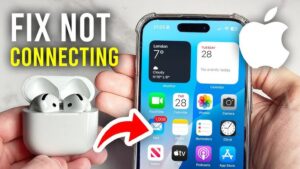
Before changing Bluetooth settings, make sure the problem is not caused by a simple issue such as a depleted battery or disabled wireless connection.
Place both AirPods inside the charging case and check that the case itself has enough battery power. If the AirPods or charging case are completely discharged, the iPhone may not detect them when you open the lid.
You should also check the battery level on your iPhone. While a low iPhone battery does not normally prevent Bluetooth from working, unexpected shutdowns or aggressive power-saving behavior can complicate troubleshooting.
Next, make sure Bluetooth is enabled.
- Open the Settings app on your iPhone.
- Tap Bluetooth.
- Make sure Bluetooth is turned on.
Do not rely only on the Bluetooth button in Control Center when troubleshooting. Depending on how Bluetooth was previously managed, Control Center may temporarily disconnect accessories without completely changing the underlying Bluetooth configuration. Checking directly in Settings makes it easier to confirm the actual status.
Also make sure Airplane Mode is turned off. When Airplane Mode is enabled, Bluetooth behavior can vary depending on your previous settings, so disabling it removes another possible cause.
Check Whether the AirPods Are Already Connected
Sometimes AirPods appear to have a connection problem when they are actually connected but not selected as the current audio output device.
Open Settings > Bluetooth and look under My Devices. If your AirPods appear with the status Connected, the Bluetooth connection itself is working.
If you cannot hear audio through them, check the audio output instead.
Start playing audio, then open Control Center. Tap the AirPlay or audio output control and select your AirPods.
You can also check the output from the Now Playing screen or supported media apps.
This situation is especially common when an iPhone is connected to several Bluetooth devices, such as a car stereo, speaker, headphones, or hearing device. The AirPods may be paired correctly, but the iPhone may continue sending audio somewhere else.
Put the AirPods Back in the Case and Try Again
A simple reconnection can clear a temporary communication problem.
Put both AirPods in their charging case and close the lid. Wait for about 15 seconds, then open the lid near your unlocked iPhone.
If the AirPods are already paired with the iPhone, a connection card or battery status window may appear on the screen. Put the AirPods in your ears and test whether they connect.
If nothing happens, leave the lid open and go to Settings > Bluetooth. Look for the AirPods under My Devices and tap them if they are listed.
This method works because placing the AirPods back in the case temporarily ends the active connection and gives the iPhone another opportunity to establish it.
Make Sure Both AirPods Are Charging Properly
If one AirPod is not making proper contact with the charging case, it may have a very low battery or be completely turned off. This can sometimes create confusing connection behavior.
Open the case near your iPhone and check the battery levels. If one AirPod shows a significantly lower charge than the other, remove it and place it back into the case carefully.
Check the charging contacts inside the case for visible dirt or debris. Also inspect the bottom of each AirPod.
Do not insert metal objects or sharp tools into the charging case. If cleaning is necessary, use a soft, dry, lint-free material suitable for electronics. Moisture inside the charging case can cause additional problems.
After confirming that both AirPods are charging, leave them in the case for several minutes before trying to connect again.
Turn Bluetooth Off and Back On
Bluetooth can occasionally become stuck in a temporary state where the iPhone can see a device but cannot establish a stable connection.
To restart Bluetooth:
- Open Settings.
- Tap Bluetooth.
- Turn Bluetooth off.
- Wait about 10 seconds.
- Turn Bluetooth back on.
Then open the AirPods case near the iPhone and try connecting again.
Turning Bluetooth off and back on is more useful than repeatedly tapping the AirPods in the device list. It forces the iPhone to restart its active Bluetooth connection process without removing your saved pairing information.
If the AirPods connect after doing this but continue disconnecting later, continue with the other troubleshooting steps rather than assuming the problem is permanently fixed.
Restart Your iPhone
Restarting the iPhone can resolve temporary problems involving Bluetooth, background processes, or system services.
The exact restart method depends on your iPhone model.
For most newer iPhones:
- Press and hold the Side button and either Volume button.
- Drag the power slider when it appears.
- Wait for the iPhone to turn off completely.
- Turn it back on.
For iPhones with a Home button, the process may require holding the Side or Top button instead.
Once the iPhone has restarted, unlock it, make sure Bluetooth is enabled, and open the AirPods case nearby.
A restart does not remove your AirPods pairing or erase any personal data. It is therefore a sensible step before resetting network settings or removing the AirPods from your Apple Account.
Disconnect Other Devices That May Be Using the AirPods
AirPods can automatically switch between Apple devices associated with the same Apple Account. This is convenient when it works correctly, but it can occasionally make it seem as though the AirPods are refusing to stay connected to the iPhone.
For example, you may start playing audio on your iPhone while the AirPods are also being used with a nearby Mac, iPad, or another Apple device.
Check nearby devices that use the same Apple Account and temporarily disconnect the AirPods from them. Then try connecting them to the iPhone again.
If the problem is frequent, you may want to change the automatic connection behavior.
Go to Settings > Bluetooth, tap the information button next to your AirPods, and look for the automatic connection setting. Depending on your iOS version and AirPods model, you may be able to change the behavior from automatic switching to connecting when the AirPods were last connected to that iPhone.
This can be useful for people who regularly use several Apple devices at the same desk or workspace.
Forget the AirPods and Pair Them Again
If the AirPods appear in the Bluetooth list but repeatedly fail to connect, removing the existing pairing and creating a new one can solve the problem.
This is often the right next step after restarting Bluetooth and the iPhone.
Remove the Existing Pairing
- Open Settings > Bluetooth.
- Find your AirPods under My Devices.
- Tap the information button next to their name.
- Choose Forget This Device.
- Confirm the decision.
Depending on your Apple Account and software version, removing AirPods may also affect how they are associated with other devices connected to the same account.
After forgetting the AirPods, place them in the charging case and close the lid for a few seconds.
Pair the AirPods Again
Open the lid with the AirPods inside and hold the setup button on the charging case until the status light indicates pairing mode. The exact location and behavior of the status light can differ by AirPods model.
Hold the open case near your unlocked iPhone and follow the setup instructions that appear.
If the setup animation does not appear, go to Settings > Bluetooth and look for the AirPods under available devices.
Once the pairing is complete, test the connection by playing audio and briefly locking and unlocking the iPhone. This helps confirm that the AirPods are not only pairing successfully but also reconnecting normally.
Reset the AirPods if Re-Pairing Does Not Work
Resetting the AirPods removes their existing connection configuration and returns them to a state where they can be set up again.
This is more disruptive than restarting Bluetooth, so it is usually best to try it after simpler methods have failed.
The general process is:
- Place both AirPods in the charging case.
- Close the lid and wait briefly.
- Open the lid.
- Use the setup or case control button according to your AirPods model until the status light shows the reset sequence.
- Bring the case near your iPhone and set the AirPods up again.
The exact reset procedure can differ between AirPods generations and case designs. If your model does not respond to the standard button procedure, check the instructions specific to that AirPods model before assuming the hardware is faulty.
After the reset, reconnect the AirPods as if you were pairing them for the first time.
A successful reset can fix problems caused by corrupted pairing information, failed device switching, or connection settings that continue to cause problems after a normal re-pair.
Update Your iPhone Software
An outdated version of iOS can sometimes contribute to Bluetooth compatibility or connectivity problems, particularly if the issue started after changes to other devices or accessories.
To check for an update:
- Open Settings.
- Tap General.
- Select Software Update.
- Install any available update if appropriate.
Before installing a major update, make sure the iPhone has sufficient battery power or is connected to a charger.
AirPods firmware updates are handled differently from iPhone updates. There is generally no manual button on the iPhone that lets you select and install a particular AirPods firmware version. Firmware updates are normally installed automatically when the required conditions are met.
If your AirPods have a persistent issue that affects only one model or firmware version, checking the current software information can help identify whether the problem is related to a known compatibility issue.
Check for iPhone Bluetooth Problems
If your AirPods will not connect but other Bluetooth devices are also failing, the problem may be with the iPhone rather than the AirPods.
Try connecting another known working Bluetooth device, such as headphones, a speaker, or a car system.
If other Bluetooth devices connect normally, focus on the AirPods pairing and reset process.
If multiple devices fail to connect, test the following:
- Turn Bluetooth off and back on.
- Restart the iPhone.
- Install available iOS updates.
- Check whether the problem occurs in different locations.
- Remove and reconnect one other Bluetooth accessory to see whether the issue is isolated.
Interference can also affect Bluetooth performance. Wi-Fi equipment, crowded wireless environments, and physical obstacles can reduce connection quality, although they do not usually prevent properly functioning AirPods from appearing in the Bluetooth settings when they are nearby.
Reset Network Settings Only When Necessary
If Bluetooth and Wi-Fi connections are experiencing persistent problems, resetting network settings can be useful.
This is not the same as simply restarting Bluetooth. A network settings reset removes saved Wi-Fi networks and passwords, cellular settings, VPN settings, and other network-related configurations.
Before using this option, make sure you know the passwords for Wi-Fi networks you need to reconnect to.
On recent versions of iOS, the option is generally found under:
Settings > General > Transfer or Reset iPhone > Reset > Reset Network Settings
The iPhone will restart as part of the process.
Afterward, turn Bluetooth back on and pair the AirPods again if necessary.
Because this step affects more than the AirPods, it should not be the first solution you try. It makes more sense when the iPhone has broader connectivity problems that simpler troubleshooting has not resolved.
What to Do When Only One AirPod Connects
When only the left or right AirPod connects, check the battery level of each one first.
A single AirPod may fail to connect simply because it did not charge correctly in the case. Place both AirPods back in the case, confirm that they are seated properly, and charge them.
If both have sufficient power, reconnect them to the iPhone. You can then try forgetting and pairing the AirPods again.
If the same AirPod repeatedly fails while the other works normally, inspect the charging contacts and test whether the affected AirPod is recognized by the case.
A persistent one-sided connection problem can point to a battery, charging, or hardware issue. A reset may help if the problem is software-related, but it cannot repair a damaged AirPod or a failing battery.
What If the AirPods Do Not Appear on the iPhone at All?
If the AirPods do not appear in the Bluetooth list and no setup screen appears, focus on pairing mode.
Put both AirPods in the case, open the lid, and activate pairing mode using the appropriate control for your model.
Keep the case close to the iPhone and make sure the iPhone is unlocked.
If the AirPods still do not appear, try the following:
- Charge the case and both AirPods.
- Restart the iPhone.
- Turn Bluetooth off and back on.
- Reset the AirPods.
- Test the AirPods with another compatible device.
Testing with another device is particularly useful because it helps identify where the problem is located.
If the AirPods cannot be detected by any compatible device after charging and resetting them, the issue is more likely to involve the AirPods or charging case. If they work normally with another device but not your iPhone, continue troubleshooting the iPhone’s Bluetooth and software settings.
Avoid These Common Troubleshooting Mistakes
One common mistake is repeatedly opening and closing the AirPods case without checking whether the iPhone can actually see the AirPods. This can waste time when the real issue is an existing corrupted pairing or disabled Bluetooth.
Another is immediately resetting network settings. While that can solve broader connectivity problems, it also removes saved network information and is unnecessary when the issue is limited to one pair of AirPods.
It is also easy to confuse a pairing problem with an audio routing problem. If the AirPods show Connected, check where the iPhone is sending audio before resetting anything.
Finally, avoid assuming that a reset will solve a physical fault. If an AirPod will not charge, the case does not respond, or the device cannot be detected by any compatible device, repeated resets are unlikely to repair damaged hardware.
When to Contact Apple Support
If you have charged the AirPods, restarted the iPhone, forgotten and re-paired them, reset the AirPods, and tested them with another compatible device, you should have enough information to narrow down the source of the problem.
Contact Apple Support or an authorized service provider if:
- The AirPods cannot be detected by any compatible device.
- One AirPod consistently fails to charge or connect.
- The charging case does not respond or show normal charging behavior.
- The AirPods disconnect repeatedly after being reset and tested with different devices.
- Your iPhone has Bluetooth problems with several unrelated accessories.
Before seeking service, note exactly what happens during the connection attempt. Details such as whether the AirPods appear in Bluetooth settings, whether only one AirPod connects, and whether they work with another device can make diagnosis much easier.
Conclusion
Most AirPods connection problems on an iPhone can be resolved without replacing the AirPods or changing advanced settings. Start by checking battery levels and Bluetooth, then reconnect the AirPods, restart the iPhone, and rule out conflicts with other Apple devices.
If the problem continues, forgetting and pairing the AirPods again or resetting them can clear corrupted connection information. Resetting network settings should be reserved for situations where the iPhone has wider connectivity problems.
The most useful troubleshooting step is often identifying where the failure occurs. If the AirPods work with another device, the iPhone or its settings deserve more attention. If the AirPods cannot connect to any compatible device after charging and resetting them, the AirPods or charging case may require service. Working through the steps in this order gives you the best chance of fixing AirPods connection problems on iPhone without performing unnecessary resets or losing other saved settings.
If you think there’s been a mistake here, please do let us know by commenting on this post or Contact Us. And a member of our Content Integrity Team will review this decision with you.